
Introduction
India has quickly become one of the most influential space exploration powers in the world. The milestones established in the last 20 years at Indian Space Research Organisation (ISRO) have changed the way the world regards the cost-effective and revolutionary missions in space. All are now waiting eagerly to Chandrayaan-4 after the historic Chandrayaan-3 in 2023 that made India the first country to land a spacecraft to the lunar south pole.
Chandrayaan-4 Mission (2025) is likely to be the most ambitious Indian lunar mission so far. However, Chandrayaan-3 proved its landing skills, Chandrayaan-4 will see India take its research on the moon to a new level and with advanced scientific experiments, potential analysis of the soil, further exploration of the lunar ice as well as even preparing future manned missions.
This paper is a detailed introduction to Chandrayaan-4, its purpose, its technology, its role in the future of space exploration, and its importance to the world.
The Journey So Far- Chandrayaan-1 to Chandrayaan-3
Chandrayaan-1 (2008) – the First Indian Mission to the Moon
- Chandrayaan-1 was the first Indian mission to the moon which was launched in October 2008.
- It flew round the Moon and discovered some historic water molecules on the lunar surface.
- This finding made the world believe that the Moon was an object of colonization in the future.
- Although the mission did not last much more than one year (the last contact with them was lost in 2009), it was celebrated as a breakthrough success.
Chandrayaan-2 (2019) – Lessons of failure
- Chandrayaan-2 had an orbiter, lander (Vikram) and rover (Pragyan).
- The orbiter is still performing extremely well, but the lander crashed during descent.
- The experiment that failed was one that had been done on the accuracy of landing technology. ISRO took this failure as an inspiration to Chandrayaan-3.
Chandrayaan-3 (2023)- Indian Victory of the Past
- ISRO successfully landed the Chandrayaan-3 Vikram lander on the lunar south pole on 2 August 2023.
- India was the first nation in the world to do this.
- The mission not only verified the presence of water ice in much more detail but also provided useful surface analysis.
- It improved the image of India in the whole world and inspired Chandrayaan-4.
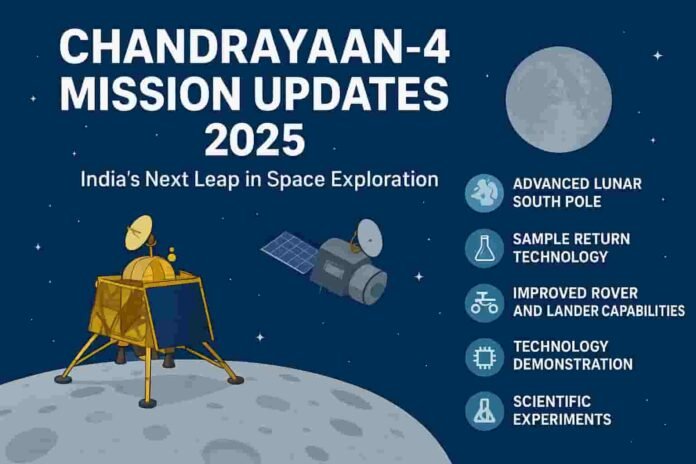
Chandrayaan-4 (2025) Mission Objectives
The Chandrayaan-4 is a mission with grand objectives that surpass past lunar missions:
Premier South Pole Lunar Mission.
Carry out more studies on water ice reserves.
Identify the location of natural resources that would be utilized in human settlements in the future.
Sample Return Technology (Possibility)
Among the supposed characteristics is the effort by India to bring lunar soil samples back to earth.
This would make India part of the elite club of nations (US, Russia, China) in case it was successful.
Increased Rover and Lander Capability.
Better strength to endure lunar nights (14 earth days of extreme cold).
More intelligent AI-driven navigation of rovers.
Technology Demonstration
Mars and deep space future technologies.
Techno-innovation partnership with private space startups.
Scientific Experiments
Learn geology and tectonic action of the moon.
Test solar energy on the Moon surface.
Examine the amount of radiation around possible human settlement.
Read also : https://atozjournal.com/fastest-growing-cities-india-2025/821/
International Collaborations
NASA (USA): Future Cooperation on radiation and water experiments on the moon.
JAXA (Japan): JAXA probably has a role in high-tech robotics.
ESA (Europe): The possibility of communicating and sharing data via satellite.
Such alliances are an indicator that Chandrayaan-4 will not only remain an Indian project, but also a science project globally.
The Indian Private Space Companies Role.
The private space industry of India has grown at a fast rate through the IN-SPACe program. There are active startups that are developing technology to support Chandrayaan-4: Skyroot Aerospace, Agnikul Cosmos, and Pixxel.
The lander parts, AI-driven navigation and miniaturized payload could be supplied by the private businesses.
This is one of the public- private alliances that make India a leader in the global space economy that is worth 500 billion dollars.
Chandrayaan-4 is scientifically important
Water Ice Discovery – The key to drinking water, fuel production, and human colonies in the future.
Lunar Soil Study – How to know more about the geology of the Moon and the possibility of mining there.
Solar Energy – The Moon may become a solar power center on Earth someday.
Radiation Testing – Cosmic radiation data will be useful in the design of astronaut safe habitats.
Space Farming Experiments (Possibility) – Experiments to determine whether it is possible to grow plants in lunar soil.
Challenges Ahead
Precision Landing– Despite the success of Chandrayaan-3, landing on rough surfaces is dangerous.
Extreme Temperatures – Survival on the Moon is one of the largest engineering problems.
Funding & Timelines– Financial constraints will be a barrier to progress.
Global Competition – China, USA and Russia are fiercely developing their missions to the moon.
Global Impact & Comparisons
USA: The Artemis Program of NASA is designed to land astronauts on the Moon once again by 2026.
China: By 2030 we will have a permanent lunar base.
Russia: In trouble over delays in its Luna program.
India: As a unique and cost-efficient and innovative game-changer, Chandrayaan-4 will have global significance.
Chandrayaan-4 and Space Economy in India
- The space sector in India is expected to hit a mark of 40 billion dollars in the year 2040.
- Chandrayaan-4 will draw investors all over the world, stimulate the development of the private space and generate thousands of jobs.
- It will also enhance the strategic and defense power of India in space.
India and the Future, Beyond the Moon
Chandrayaan-4 is not only a scientific mission, but it is a reflection of vision of India in future. Through science and technology and global cooperation, India is establishing the base of becoming a space superpower.
It represents not only a trip to the Moon but the future of man in the space. Chandrayaan-4 is showing the world that India is prepared to take the lead in the new age of exploration, innovation, and interplanetary discovery.
Read also : https://atozjournal.com/stock-market-trends-india-2025/818/

